For Property Managers

One registry across every property you manage.

Quarterly owner reports that assemble themselves. Service event history that travels with the property when it transitions to a new owner. Contractor coordination that doesn't require chasing invoices and asking what happened. The professional credibility your owner-clients are paying you for — built into the operational record, not the marketing deck.

Flat
Rate Per Property
One flat rate per property per year. A single-family rental, a duplex, a four-plex, or a 50-unit apartment building each count as one property. Covers every system at that address.
50
Founding Partner Spots
Fifty founding PM partnerships across North America. First come, first served. Founding rate locked for 24 months from enrollment.
Quarterly
Owner Reports That Self-Assemble
Capital event summaries, service history, condition status — structured per property, ready to package as quarterly statements without your team rebuilding them from invoices each cycle.
What Changes For Your Firm

Three concrete shifts in how owner reporting works.

AHR isn't a property management platform. It's the asset-record layer underneath the work your team already does — making the operational details your owner-clients want visible, transferable, and structured.

// Shift 01
Owner reports that build themselves.
Today: your team spends hours per quarter assembling owner statements from invoices, notes, and memory. Tomorrow: structured per-property records pre-built from the service events your contractors signed throughout the quarter. Your team formats and reviews; the data is already there.
// Shift 02
Contractor coordination without the chasing.
When your contractors sign records, you know what was done at every property without phone calls or email threads. Owner-client asks "what was done on Unit 304?" — you open the property's record and answer immediately. The information that's already in your contractors' heads becomes data you can act on.
// Shift 03
New-owner pitches land on credibility.
When pitching prospective owner-clients, you can show them what the operational record looks like for your existing book — not promises, actual structured data per property. Your firm differentiates on what you do, not what you say.
What Lives In The Record

Everything your owner-clients want to know — without having to ask.

For each property under management, the record captures what owner-clients actually pay your firm to track and report.

Service event history
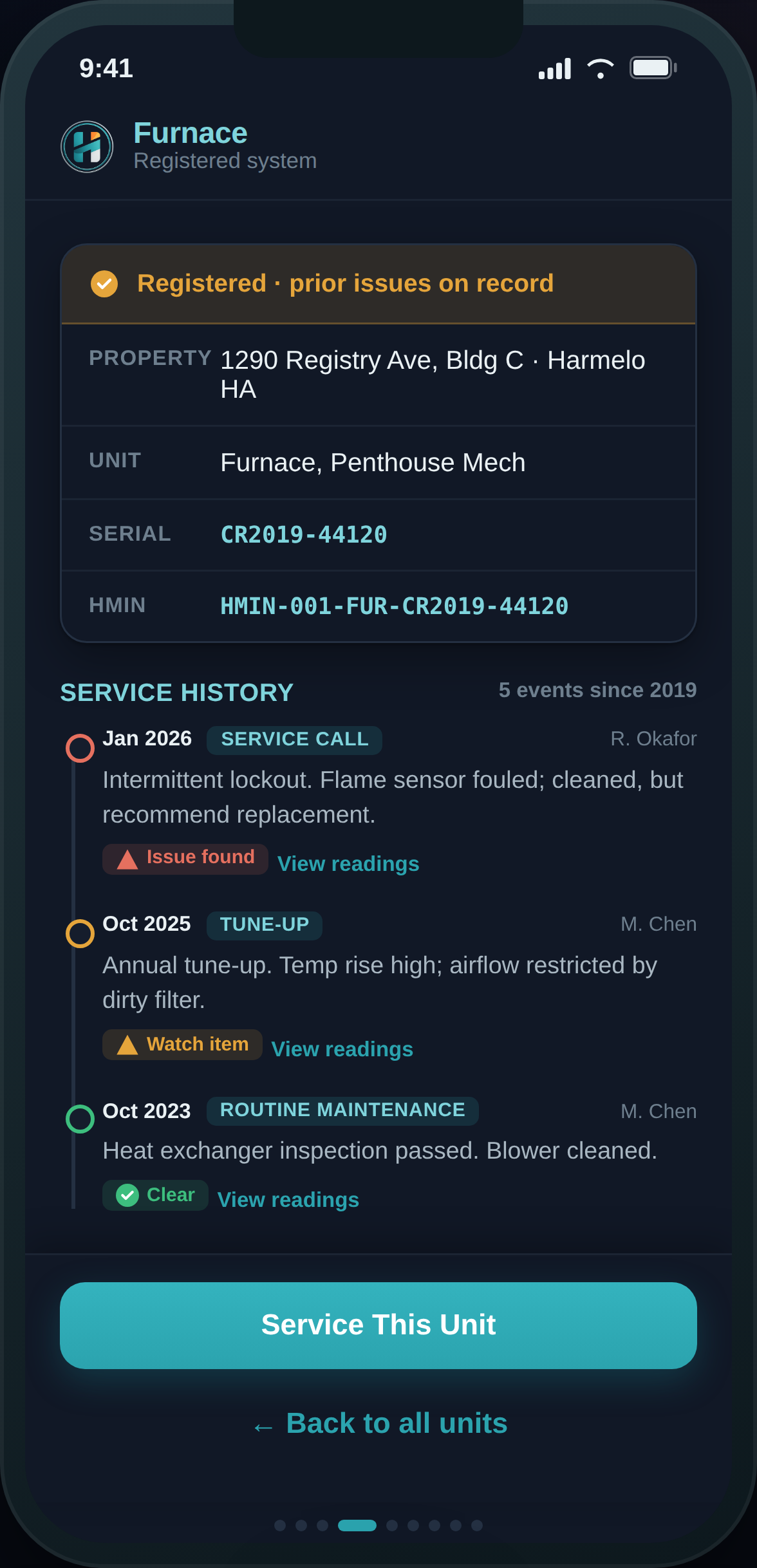
Every contractor visit, repair, replacement, or inspection — signed by the contractor, attached to the property. Searchable by property, by date, by system.
Capital event tracking
When a system is replaced, upgraded, or retired, the record shows what came out, what went in, when, and why. Capex planning becomes data-driven instead of memory-driven.
Condition status per property
A current condition snapshot per property — aging systems flagged, warranty expirations visible, replacement windows surfaced before failure.
Warranties and permits on file
Manufacturer warranties, permit numbers, inspection certificates — attached to each system, accessible when owner-clients ask or when systems need to be serviced.
Contractor performance visibility
Across your managed book, which contractors actually perform the work they sign for. Useful when choosing who to send to which property, and when reviewing contractor relationships annually.
Owner-client reporting packages
Per-property and portfolio-level summaries structured for owner reports. Your team adds narrative and context; the operational data is pre-assembled.
Property Manager Partnership

Founding partnerships, scoped to your book.

We are onboarding a small founding cohort of management firms right now, with reduced membership and a 24-month rate lock for the early partners. What it costs depends on how many properties you manage, so the right number is a short conversation rather than a checkout page.

Founding cohort · open now · 50 spots

Tell us roughly how many properties you manage, and we will scope founding terms that fit your book, with onboarding support for your transition and a rate lock held for the founding period.

Request founding terms →
Prefer email? partnerships@harmelo.com
Who PM Partnership Is For

Built for firms managing other people's properties.

Property Manager partnership is structured specifically for firms operating buildings on behalf of third-party owner-clients — not for self-managing landlords. The structural distinction matters because the PM workflows are built around the owner-client reporting relationship.

// Best fit

Property management firms with third-party owner-clients. You hold management agreements with property owners; your revenue is the management fee, not the asset return; the buildings on your registry aren't yours, you're the operator. Single-family rental managers, multifamily PMs, mixed residential PMs — if you manage on behalf of other owners, the partnership fits.

// Not the right fit

Self-managing landlords (under ~50 rental properties) should use AHR per-property enrollment directly. Owner-operators of purpose-built rental buildings should use multifamily partnership. If you own and self-manage your own properties, you're not a PM in this sense — you're a landlord, and the per-property AHR is the simpler product.

What Property Managers Ask First

Honest answers to the real questions.

Is this for self-managing landlords or only for PM firms?

PM partnership is structured for firms operating buildings under management agreements with third-party owner-clients. If you own and self-manage your own rental properties, you're not a PM in this sense — you're a landlord, and per-property AHR (under ~50 properties) or multifamily partnership (over ~50 properties or shared building systems) is the correct product. The structural distinction matters because the PM platform is built around the owner-client reporting relationship.

What counts as a "property" for the per-property fee?

A property is any address you manage on behalf of an owner-client. A single-family rental, a duplex, a four-plex, or a 50-unit apartment building each count as one property. The $39/year covers every system within that property regardless of unit count — HVAC, water heater, electrical, fixtures, common-area equipment. We're charging for the management relationship, not the asset count.

Does this replace my property management software?

No. AHR is not a property management platform — it doesn't handle tenant relationships, lease management, rent collection, accounting, or vacancy marketing. Keep using whatever you use for that. AHR is the asset-record layer underneath your work, focused specifically on the mechanical and energy system history that owner-clients want visible.

How do I share records with my owner-clients?

Owner-clients can be granted permissioned access to records for properties they own, with the scope you control. They see what you choose to share — full operational visibility, summary capital reports, or just specific events as they happen. Your relationship with the owner-client stays yours; we provide the data layer.

What if an owner-client wants to take their property data when they leave?

The record stays with the property. If an owner-client moves their property to a different management firm, the property's record is theirs — the next PM can be granted access by the owner. The record was always about the property, not the management relationship.

How does this work with the contractors I already use?

Contractors you regularly work with can be invited to enroll on the registry — founding contractor membership is currently open and they get the founding rate locked for life if they enroll early. For contractors not yet on the registry, your team can enter records on their behalf with their documentation attached. The verified-by-signature workflow works best when the contractor signs directly, but it's not a blocker for participation.

What Asset History Report is not

Honest about what we do and don't do.

AHR is a record. It is not a contractor management service, a property management platform, a credentialing authority, or a substitute for the management agreements and contractor relationships property management firms operate under.

Permits & municipal compliance

We do not pull permits, contact municipalities about permits, pay for permits, or verify that a permit is on file with the relevant authority. Permit numbers attached to records reflect what the contractor entered; verification with local authorities is the responsibility of the permit-holder.

Inspection & workmanship

We do not perform, supervise, certify, or verify the quality of any work performed. We are not licensed contractors, engineers, or building inspectors. The registry verifies that the contractor signing a record is a real, credentialed, insured tradesperson; the workmanship itself is between the property manager, the contractor, and the owner-client.

Service, dispatch & warranties

We do not perform, schedule, dispatch, quote, or charge for service work. We do not issue, manage, transfer, or honor warranties. Warranty documents on the record are stored for reference; we don't administer or enforce them.

Contractor supervision & liability

AHR does not supervise contractors, manage contractor scheduling, or assume responsibility for contractor performance. Property managers contract with service providers directly; the registry captures what contractors sign for. Disputes about workmanship, scope, or pricing are handled directly between the property manager, the owner-client, and the contractor.

Insurance, bonding & licensing

We verify contractor credentials at onboarding (license, insurance, bonding documentation). We do not provide insurance, bonding, or licensure ourselves. Ongoing compliance — license renewals, insurance maintenance, jurisdiction-specific certifications — is the contractor's responsibility. Property managers should follow their own credentialing protocols in addition to registry verification.

Owner-client agreements

We do not draft, manage, or administer management agreements between property managers and owner-clients. AHR produces records and reports the property manager can share with owners; the underlying management relationship, fee structure, and reporting obligations are set in the property manager's own contracts with their owner-clients.

The record is the record — not a substitute for the professional judgment, regulatory processes, or contractual relationships that govern property management. Our role is to keep the record straight, structured, and accessible to the parties who need it.

See It Working

The portfolio view your owner-clients pay for.

Every property you manage, every system on the record, owner reports that assemble themselves — this is the operator console behind that. Open it and walk a real portfolio.

Interactive demo · best viewed on desktop

Ready to give your owner-clients structured visibility?

Founding PM partnerships are open. Fifty spots, first come, first served. We'll walk you through the partnership structure, the owner-client reporting workflow, and how the registry fits with your existing operations.

Start a Conversation →